Read one aloud yourself, or press Listen and a calm narrator reads it while the words light up as they are spoken. Every story ends quietly, ready for lights out.
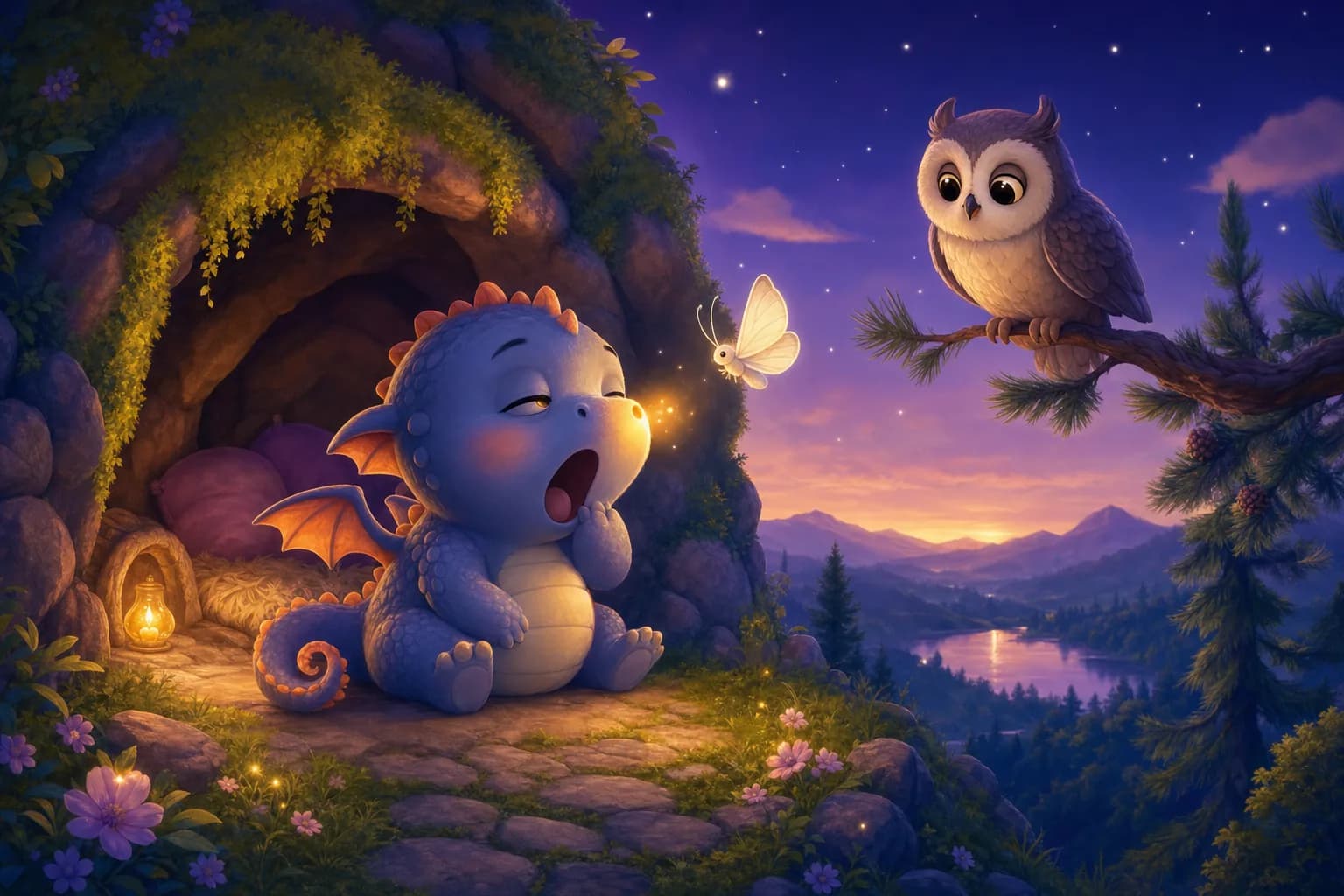
High on a hill, in a cave lined with soft green moss, lived a little dragon called Ember.
Ember had small orange wings, a curly tail, and a nose that glowed like a candle when he was happy.
Every night, when the sky turned purple, Ember's mother would say, "Time for sleep, my spark." And every night, Ember would yawn a big, warm dragon yawn, curl his tail around his toes, and drift away.
But tonight, something was different.
Ember opened his mouth. He waited. Nothing happened.
"Mother," he said, "I think I have lost my yawn."
His mother smiled. "Yawns are never really lost," she said. "Sometimes they wander off for a little walk. Why don't you go and look for it? Go slowly. Yawns don't like to be rushed."
So Ember padded to the mouth of the cave and looked out at the quiet hillside.
On a branch of the old pine tree sat Owl, blinking her round golden eyes.
"Owl," whispered Ember, "have you seen my yawn?"
Owl thought for a moment. "I have not seen it," she said, "but I know where yawns like to hide. They hide in slow breaths. Breathe in, as if you are smelling a flower. Breathe out, as if you are cooling your soup."
Ember breathed in, slow and deep. He breathed out, soft and long. His shoulders felt a little lower. But still, no yawn.
He thanked Owl and walked on, past the sleeping daisies, until he reached the pond.
On a lily pad sat Frog, humming a low, sleepy hum.
"Frog," said Ember, "have you seen my yawn?"
"Not today," said Frog. "But yawns love quiet sounds. Listen with me."
So Ember sat by the water and listened. He heard the reeds swishing. He heard a cricket singing far away. He heard the water lapping, lap, lap, lap, against the stones. His eyes felt a little heavier. But still, no yawn.
He thanked Frog and turned back toward home.
Halfway up the hill, a soft white moth landed on the tip of his nose.
"Hello, Ember," said the moth. "You look like someone who is almost ready for bed."
"I can't be," said Ember. "I have lost my yawn."
The moth laughed a tiny, fluttery laugh. "Then let me tell you a secret. You have been carrying it all along. It was just waiting for you to be still."
Ember walked slowly into the cave. The moss was cool and soft. His mother was waiting, her wings folded like a blanket.
He lay down beside her. He breathed in, as if smelling a flower. He breathed out, as if cooling his soup. He listened to the quiet.
And then, from somewhere deep inside, came a yawn. A big, warm, wonderful dragon yawn.
"There it is," whispered his mother.
Ember curled his tail around his toes. His nose glowed softly, once, twice. And then the little dragon was fast asleep.
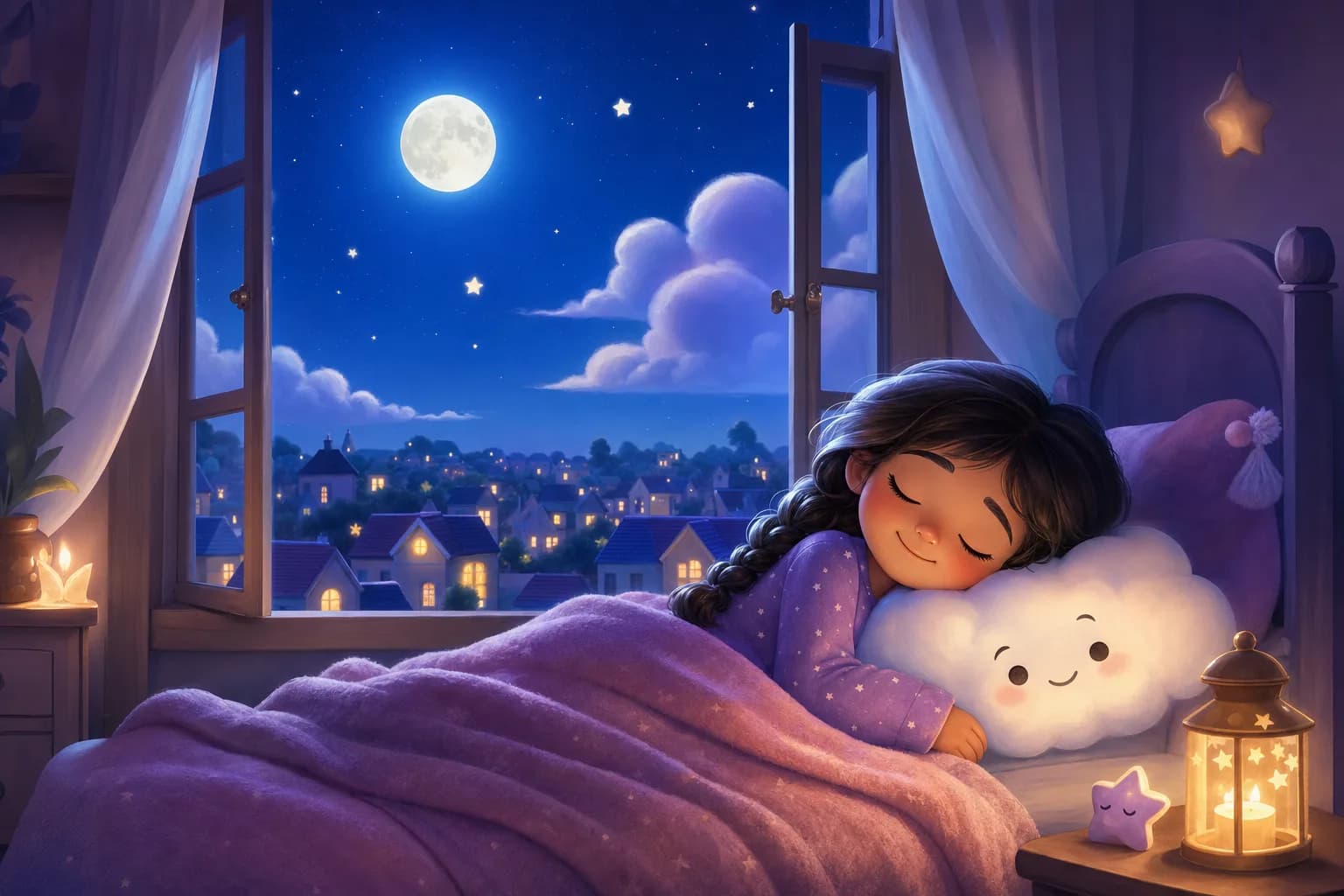
Nora was almost asleep when she heard a tiny tink against her window.
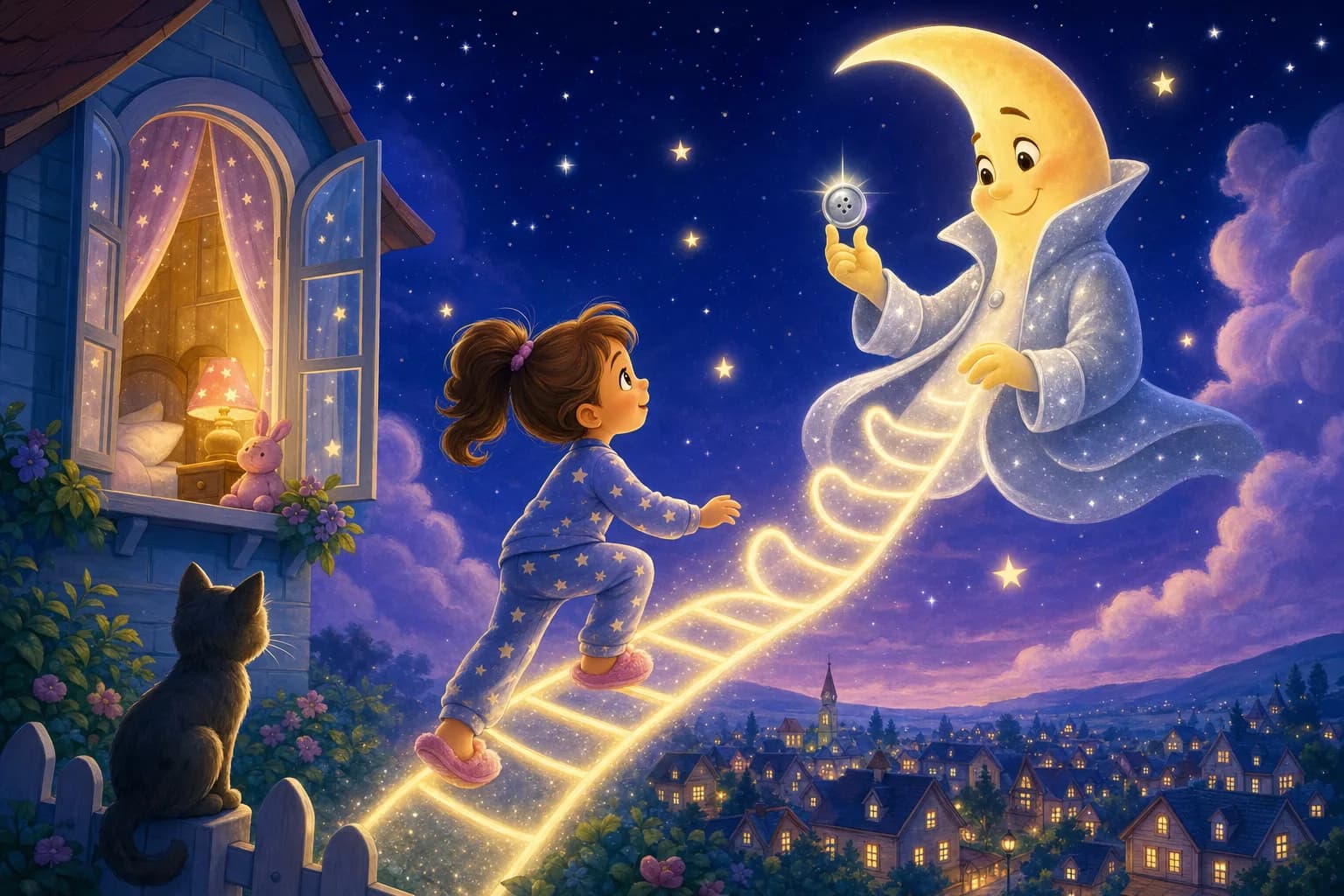
She sat up. There, on the windowsill, something was shining. It was a button. A small, round, silver button, glowing as softly as a night-light.
Nora held it in her hand. It felt cool, like a pebble from a stream.
"I wonder who this belongs to," she whispered.
She looked out of the window. The sky was dark blue and full of stars, and in the middle of it hung the Moon. But the Moon looked a little worried. Her silver coat was flapping open in the breeze, and one button was missing.
"Oh," said Nora. "It's yours."
The Moon looked down and gave a small, hopeful smile. Then, very slowly, a ribbon of moonlight stretched down from the sky until it rested on Nora's windowsill, like a ladder made of light.
Nora put on her slippers. She tucked the button into her pajama pocket. And she began to climb.
Each step was soft and springy, like walking on a feather bed. Below her, the town grew smaller. The houses had their lights turned off. The streets were quiet. A cat on a fence looked up and blinked at her.
Higher and higher she climbed, past a cloud that smelled like rain, past a sleepy bird tucked under her wing.
At the top, the Moon was waiting.
"Thank you for coming," said the Moon, in a voice like a lullaby. "That button keeps my coat closed on cold nights. Without it, I let in the wind, and I can't keep the world calm."
Nora held up the button. The Moon bent down, and Nora gently pushed the button through the buttonhole. There.
The Moon's coat closed snugly. Her light grew warm and steady, and all across the sky, the stars seemed to settle down, like children getting into bed.
"How can I thank you?" asked the Moon.
Nora thought about it. "Maybe," she said with a yawn, "you could shine through my window, just a little, while I sleep."
The Moon laughed softly. "Every night," she promised. "Now, it's time to go home."
The ribbon of moonlight glowed, and Nora climbed down, slowly, slowly, one soft step at a time. Past the sleepy bird. Past the rainy cloud. Past the cat on the fence, who was now asleep himself.
She stepped back through her window and climbed into bed. The sheets were cool, and the pillow was soft.
Through the window, a gentle silver light fell across her blanket, just as the Moon had promised.
Nora looked up and whispered, "Goodnight, Moon."
And high above, the Moon, with her coat buttoned up tight, whispered back, "Goodnight, Nora."
Sami folded a little boat out of blue paper and named it Pip.
"Pip," he said, "tonight you will sail all the way to the Sleepy Harbor, where every boat goes to rest."
He set Pip down in the stream at the bottom of the garden, just as the sun was going down. The water was smooth and golden. Pip bobbed once, turned in a little circle, and began to float away.
The stream was slow and gentle. It carried Pip past the tall grass, where the crickets were tuning their tiny songs. It carried him past the old stone wall, still warm from the day's sun. It carried him under a wooden bridge, where it was cool and shadowy, and out the other side, where the first star was shining.
"Good evening, star," Pip thought, if paper boats can think.
The stream grew wider and joined a quiet river. The river was dark and calm, like a long blue ribbon. Along the banks, little houses had their windows lit, orange and yellow, and one by one, the lights went out.
A duck swam alongside Pip for a while. "Where are you going, little boat?" she asked.
"To the Sleepy Harbor," said Pip.
"Ah," said the duck. "Follow the river until you hear the bells. Then you'll know you're close." And she tucked her head under her wing and drifted toward the reeds to sleep.
Pip floated on. The river went around a gentle bend. A soft mist rose from the water, and somewhere ahead, very quietly, bells began to ring. Ding. Ding. Ding. Slow and low, like someone humming a lullaby.
And there it was. The Sleepy Harbor.
It was full of boats of every kind. Big fishing boats with their nets rolled up. Little rowing boats tied together like friends holding hands. A tall sailboat with its sails folded neatly, like a bird folding its wings. They all rocked gently on the water, back and forth, back and forth.
An old lighthouse stood at the end of the harbor. Its light swept slowly across the water, and as it passed over each boat, the boat seemed to sigh and settle deeper into sleep.
Pip found a quiet spot beside a small red rowing boat.
"Welcome," said the rowing boat sleepily. "You've had a long journey. Rest now."
Pip rocked back and forth, back and forth. The bells rang softly. The lighthouse beam swept by, warm and slow. The water whispered, shhh, shhh.
Far away, at the top of the garden, Sami was in bed, his eyes already closed.
"I hope Pip got there," he murmured.
And in the Sleepy Harbor, rocking gently under the stars, one small blue paper boat was fast asleep.
In the corner of a quiet garden lived a little snail named Lula.
Lula was slow. She was slower than the ladybird, slower than the beetle, and much, much slower than the busy ants who marched past her all day long.
"Hurry up, Lula!" the ants would call. But Lula just smiled and kept going, one slow, careful slide at a time.
One evening, as the sky turned deep blue, Lula noticed something wonderful. On every leaf and every petal, tiny drops of dew were forming. And inside each drop, a little bit of starlight was shining.
"Oh," breathed Lula. "The garden is full of stars."
But then she heard a small, sad sound. It was a firefly, sitting on a blade of grass, her light flickering low.
"What's wrong?" asked Lula.
"I'm too tired to glow," said the firefly. "And the baby birds in the hedge are afraid of the dark. Every night I light their way to sleep, but tonight I don't have enough light."
Lula looked at the dewdrops, each one holding a tiny star.
"I can help," she said.
The ants laughed as they hurried home. "You? You're the slowest one in the garden!"
Lula didn't mind. She knew something the ants didn't. Dewdrops are delicate. If you rush, they break. If you are slow and careful, they stay whole.
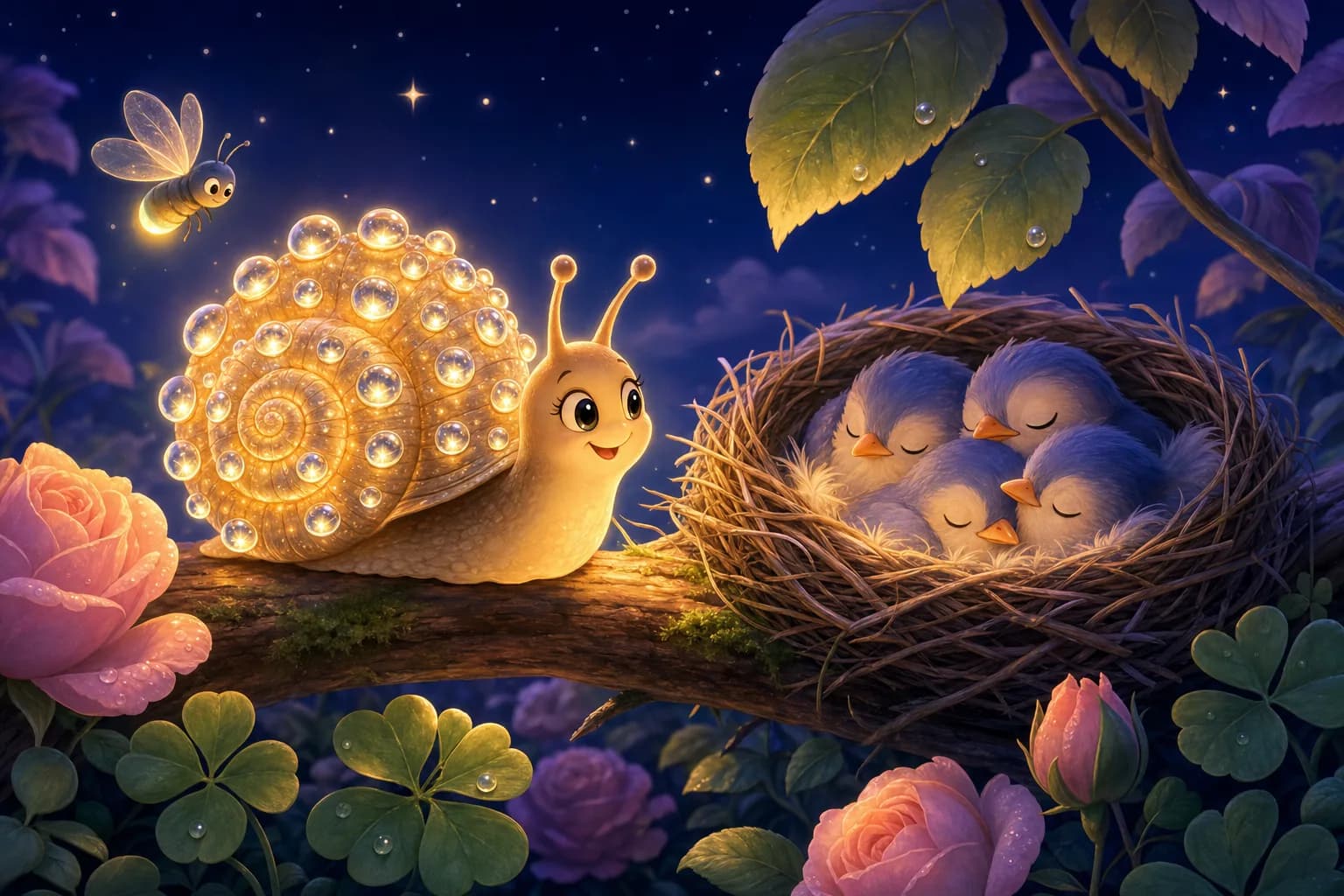
So Lula began. She found a round drop of dew on a clover leaf, and very gently, she let it roll onto her shell. It sat there, glowing. Then she slid to the next leaf, and the next, and the next. Slowly. Carefully. One drop at a time.
By the time the moon rose, Lula's shell was covered in tiny shining drops, like a little lantern made of stars.
She began the long, slow journey to the hedge. She didn't hurry. Not once. Not one drop fell.
When she reached the hedge, the baby birds peeped out from their nest. They saw Lula's shell glowing softly in the dark, and they stopped being afraid.
"It's so pretty," whispered the smallest bird.
Lula climbed up to a low branch beside the nest and settled down. The starlight from her shell spread over the nest like a soft night-light. One by one, the baby birds tucked their heads under their wings.
The firefly landed beside Lula. "Thank you," she whispered. "I could never have carried them all without breaking them."
"Being slow is good for some things," said Lula.
Down in the garden, the ants were asleep in their busy little beds. The beetle was asleep under a stone. The ladybird was asleep on a rose.
And up on the branch, glowing softly beside the nest, the little snail named Lula closed her eyes and slept, carrying the stars all night long.
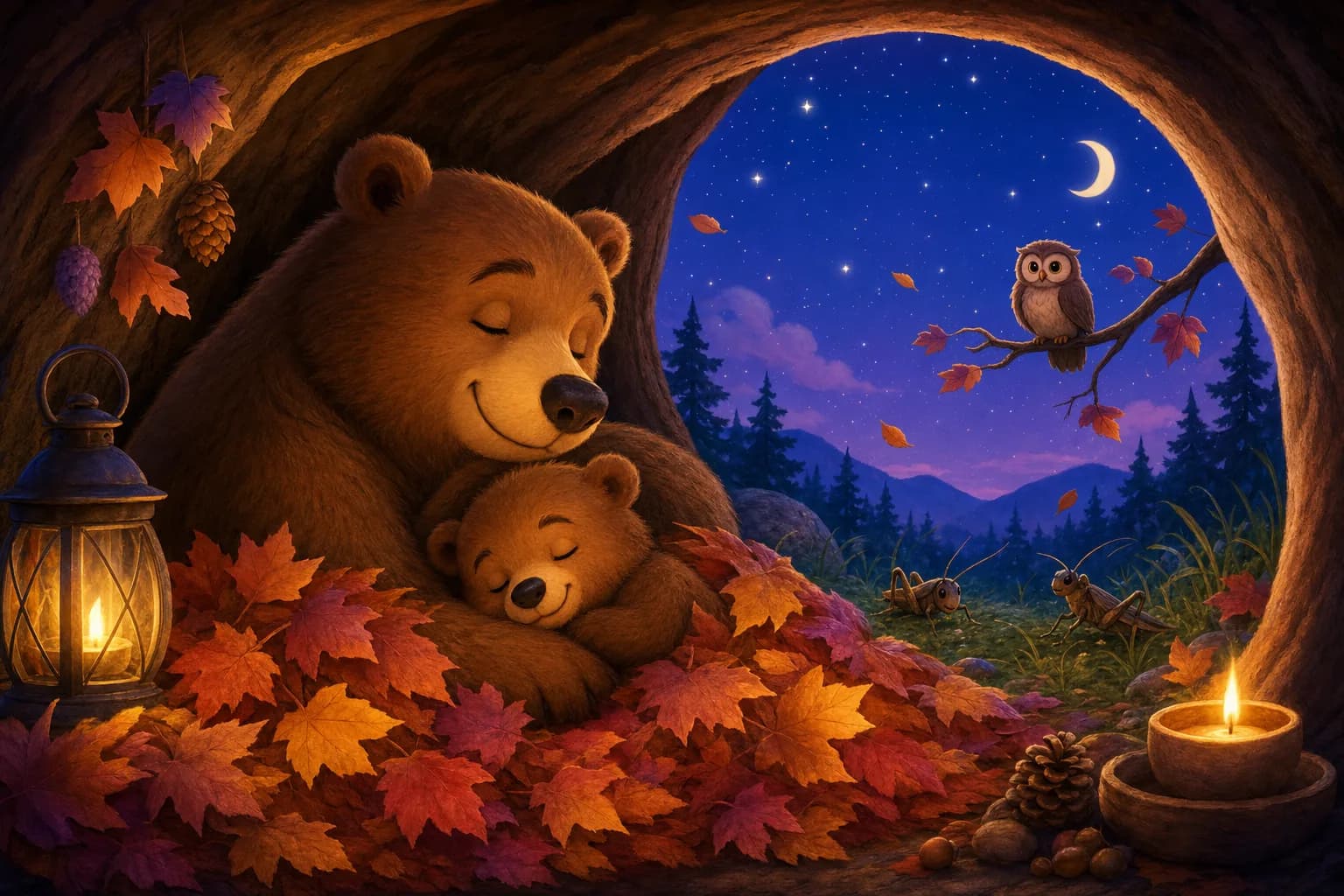
Little Bear could not fall asleep.
The den was warm. His blanket of leaves was soft. His mother was right beside him. But the forest was full of noises.
Whoooo, went something in the trees. Crick, crick, went something in the grass. Whoosh, went something through the branches.
"Mama," whispered Little Bear, "the forest is too loud. I can't sleep."
Mama Bear opened one eye and smiled. "Shall we play the listening game?" she asked.
Little Bear sat up. He loved games. "How do you play?"
"We listen to each sound," said Mama Bear, "and we find out what it really is. Then we say goodnight to it. Close your eyes."
Little Bear closed his eyes.
Whoooo, went the sound in the trees.
"What do you think that is?" asked Mama Bear.
Little Bear listened carefully. "Is it an owl?"
"It is," said Mama Bear. "Old Owl, who watches over the forest all night long so that we can rest. Shall we say goodnight to her?"
"Goodnight, Owl," whispered Little Bear.
Crick, crick, went the sound in the grass.
Little Bear listened again. The sound was small and steady, like a tiny clock. "Is it a cricket?"
"It is," said Mama Bear. "The crickets are singing the forest to sleep. It's their bedtime song."
"Goodnight, crickets," whispered Little Bear. And he noticed that the song sounded nice now, not scary at all.
Whoosh, went the sound through the branches.
This one was harder. Little Bear listened for a long time. It came, and it went away, and it came again, soft and slow.
"I know," he said. "It's the wind."
"It's the wind," said Mama Bear. "She's tucking the leaves in for the night, one by one."
"Goodnight, wind," whispered Little Bear.
Then it was quiet for a while. Little Bear lay down again and pulled his leafy blanket up to his chin.
Then he heard a new sound. It was very close. It went in, slowly, and out, slowly. In, and out. In, and out.
"Mama," he whispered, "what's that sound?"
Mama Bear chuckled softly. "That," she said, "is you, breathing. Can you make it even slower?"
Little Bear breathed in, slowly, slowly. He breathed out, slowly, slowly. His paws felt heavy. His ears felt soft.
"Goodnight, me," he mumbled.
Mama Bear kissed the top of his head.
Whoooo, went Old Owl, keeping watch. Crick, crick, sang the crickets. Whoosh, went the wind, tucking in the leaves.
And in the warm den, under his blanket of leaves, Little Bear was listening to nothing at all, because Little Bear was fast asleep.
High above a little town floated a small, fluffy cloud named Puff.
All day long, Puff watched the other clouds do important things. The big grey clouds brought rain for the gardens. The long white clouds made shade for the cows in the fields. The pink evening clouds made the sunset beautiful.
"I want to help too," said Puff. "But I'm too small to rain, and too small to make much shade, and I'm not pink at all."
As the sun went down, Puff drifted sadly over the rooftops. Below, the town was getting ready for bed. Lights were turning off. Doors were closing. Somewhere, a window was open, and Puff could hear a little girl's voice.
"I can't sleep," the girl was saying. "My pillow is too flat. And it's too hot tonight."
Puff floated a little lower to look. Inside, a girl named Mia was turning over and over in her bed. Her cheeks were pink from the warm summer air. Her pillow was squashed and lumpy.
Puff had an idea.
Very quietly, Puff floated down, down, down, until she was just outside the open window. Then she made herself as small and soft as she could, and she slipped inside.
Mia's eyes went wide. "A cloud!" she whispered.
"Shhh," said Puff. "I've come to help."
Puff floated over to Mia's bed and settled gently under her head. She was the softest pillow Mia had ever felt. Softer than feathers. Softer than cotton. Like lying on a dream.
And Puff was cool, just a little cool, like the air after a rainy day. All the warm, sticky feeling began to drift away from Mia's cheeks.
"Oh," sighed Mia. "That's much better."
Puff hummed a quiet cloud song, the kind of song that sounds like wind over a field of tall grass. Mia's eyelids began to droop.
"Will you stay?" Mia murmured.
"Until you're asleep," said Puff.
Outside, the big grey clouds had stopped raining. The long white clouds had gone still. The pink clouds had faded into the dark. And the stars came out, one by one.
Mia's breathing grew slow and even. Her hands uncurled. She was dreaming already, dreaming of floating over the town, light as a feather.
When she was deeply, deeply asleep, Puff slipped out from under her head as gently as a whisper and left a soft, cool pillow in her place, plumped and smooth.
Then Puff floated back out through the window and up into the night sky.
"Did you do something important today?" asked a big grey cloud.
Puff smiled. "I helped someone fall asleep," she said.
"That," said the big grey cloud, "is the most important thing of all."
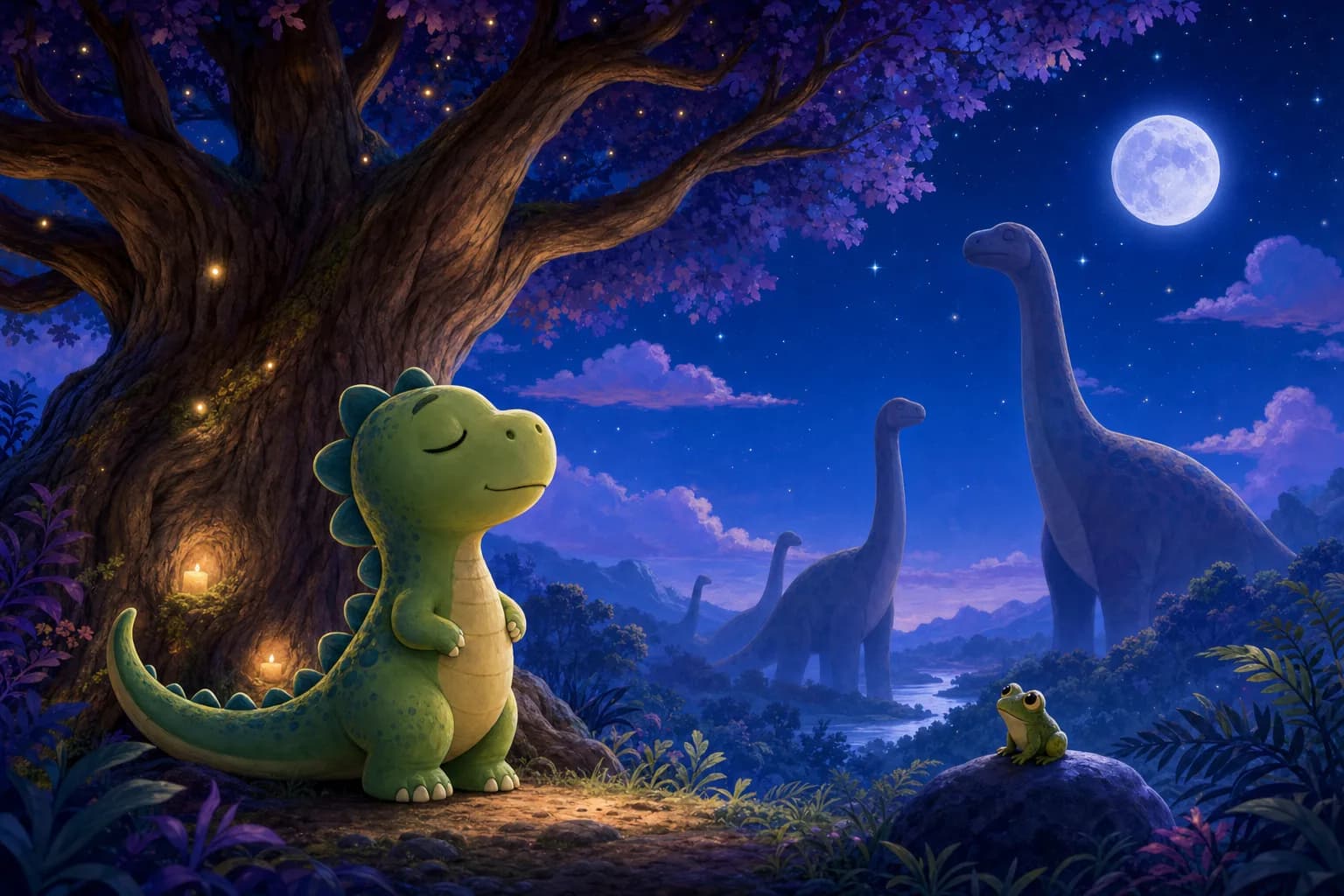
Long, long ago, in a green valley full of ferns, there lived a little dinosaur called Dash.
Dash was small for a dinosaur, about the size of a pony, with a long tail, stubby arms, and feet that were always, always moving.
All day Dash ran. He ran races with the lizards. He ran laps around the big grey rock. He ran to the river and back just to see how fast he could do it.
And when the sun went down and the valley turned gold, then purple, then blue, Dash was still running.
"Dash," called his mother from the warm nest of leaves. "Bedtime, little one."
Dash lay down. He curled his tail. He closed his eyes.
Then one foot started to tap. Then the other. Then his tail began to swish.
"I can't sleep," said Dash. "I still have running inside me."
His mother thought for a moment. "Go and ask the Old Tree," she said. "The Old Tree has watched a thousand dinosaurs fall asleep. Walk there, though. Don't run."
So Dash walked. It felt strange, going slowly. He noticed things he had never noticed while running. The ferns were damp and smelled sweet. The ground was soft under his feet. Somewhere, a frog was singing one low note, over and over.
The Old Tree stood at the edge of the valley, taller than anything, with branches that reached all the way up to the stars.
"Old Tree," said Dash, "I can't sleep. I still have running inside me."
The Old Tree rustled its leaves, slowly, the way old trees do.
"Do you see the big dinosaurs?" it asked.
Dash looked across the valley. There they were: the great long-necked ones, standing in the moonlight, as still as hills.
"They ran all day too, when they were small," said the Old Tree. "Now watch what they do."
Dash watched. The big dinosaurs were breathing. That was all. In, slowly, and the moonlight rose on their backs. Out, slowly, and it sank. In. Out. Like the sea.
"They let the running drain out through their feet," said the Old Tree. "Into the ground. The ground likes it. Try."
Dash planted his feet in the cool earth. He breathed in, slowly, like a big dinosaur. He breathed out, slowly, like a hill.
He felt something trickle out through his toes. A little bit of running. Then a little more. The ground drank it up and did not mind at all.
"Thank you," whispered Dash. His voice had gone soft.
He walked home, slowly, slowly, past the singing frog and the sweet-smelling ferns. His feet felt heavy now, in a nice way, like they belonged to him again.
He climbed into the warm nest of leaves. His mother tucked her tail around him.
"Did you find out how the big ones rest?" she asked.
But Dash did not answer. One foot gave a last tiny tap, and was still.
Across the valley, the big dinosaurs breathed in and out under the moon, and the Old Tree rustled its leaves, and the little dinosaur who could not sleep was fast asleep.
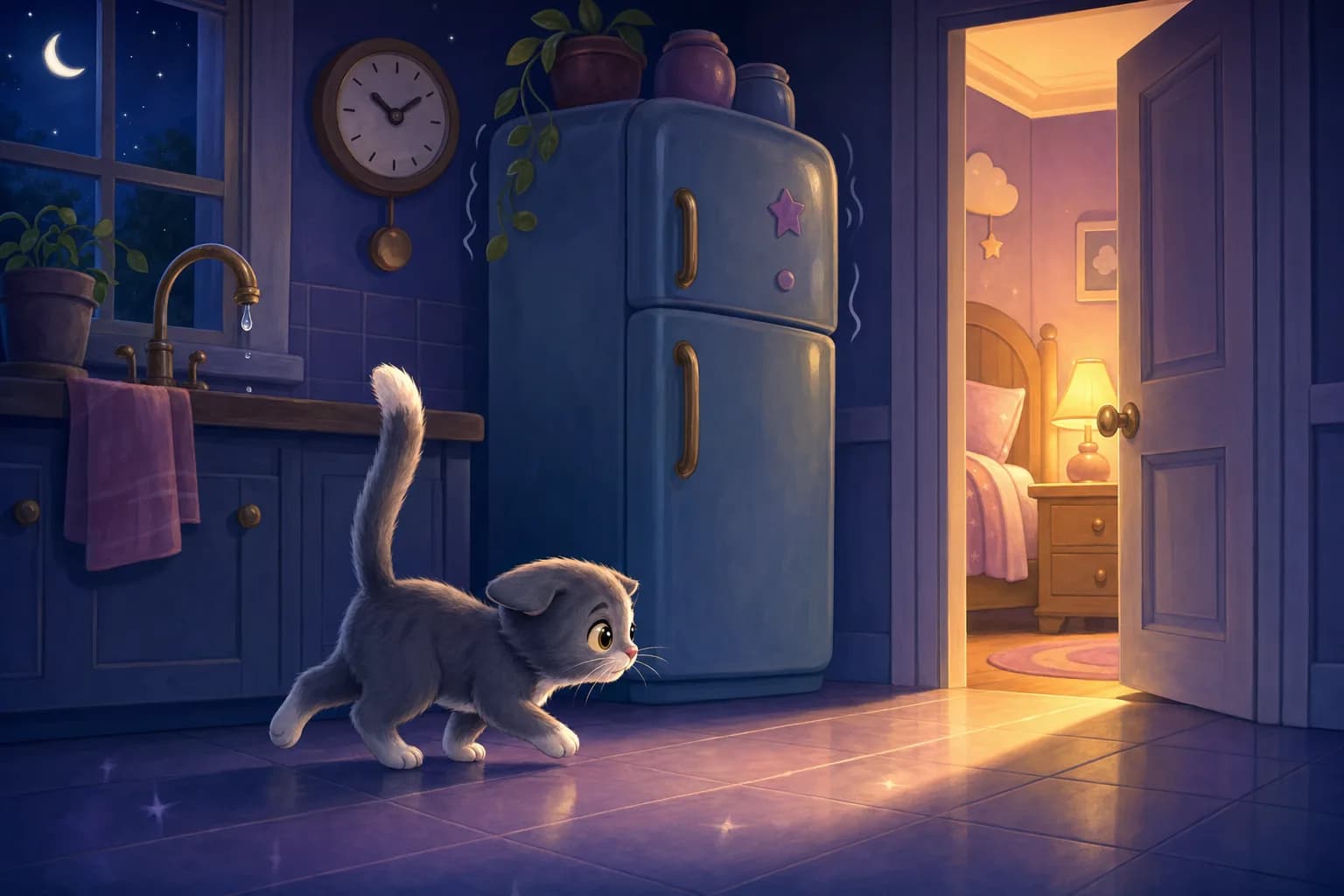
Mittens was a very small kitten with grey fur, white paws, and a tail that stood straight up like a little flag.
Today, Mittens had come to live in a new house.
The new house had tall windows and a soft rug and a girl named Ada who had carried Mittens inside, very carefully, with both hands.
All afternoon it had been wonderful. There was a bowl with her name on it. There was a ball with a bell inside. There was a patch of sun on the floor that was exactly the right size for a kitten.
But now it was night, and the house was dark, and Mittens was in a basket by herself.
Tick, tick, tick, went something on the wall.
Mittens flattened her ears. What was that?
She crept out of her basket and across the rug, one soft paw at a time, until she found it. A round thing with two thin arms, ticking away to itself.
"Oh," said Mittens. "It's only a clock." It did not look dangerous at all. It was just counting, slowly, the way clocks do.
She went back to her basket. She curled up. She closed her eyes.
Hummmmm, went something in the kitchen.
Mittens' tail puffed up. What was that?
She crept through the dark kitchen until her nose touched something tall and cold and smooth. It hummed, low and steady, like a very big bee that was not going anywhere.
"Oh," said Mittens. "It's only the fridge." She remembered now. Her bowl of milk had come out of it. It was keeping the milk cool for the morning. That was kind of it.
She went back to her basket. She curled up. She closed her eyes.
Plink. Plink. Plink.
Mittens sighed a tiny kitten sigh and went to look. It was the tap over the sink, dropping one drop at a time into a cup. Plink. Like a little bell. Like her ball.
"Only the tap," said Mittens.
The house was full of sounds, but none of them were scary, once you knew their names. The clock. The fridge. The tap. They were just the house, breathing.
Still, the basket felt very big for one small kitten.
Then Mittens heard another sound. The softest one yet. It came from down the hallway, through a door that was open a crack.
In. Out. In. Out.
Mittens padded down the hall and peeped in. There, in a bed, under a quilt covered in stars, was Ada. Fast asleep. Breathing. In. Out.
Mittens did not need to ask what that sound was. She knew it already. It was the sound of the person who had carried her inside with both hands.
She hopped up, very lightly, onto the end of the bed, and turned around three times, and settled into the warm dip beside Ada's feet.
The clock ticked. The fridge hummed. The tap went plink.
And in the middle of all the sounds of her new house, Mittens tucked her nose under her white paws, and purred, and fell asleep.
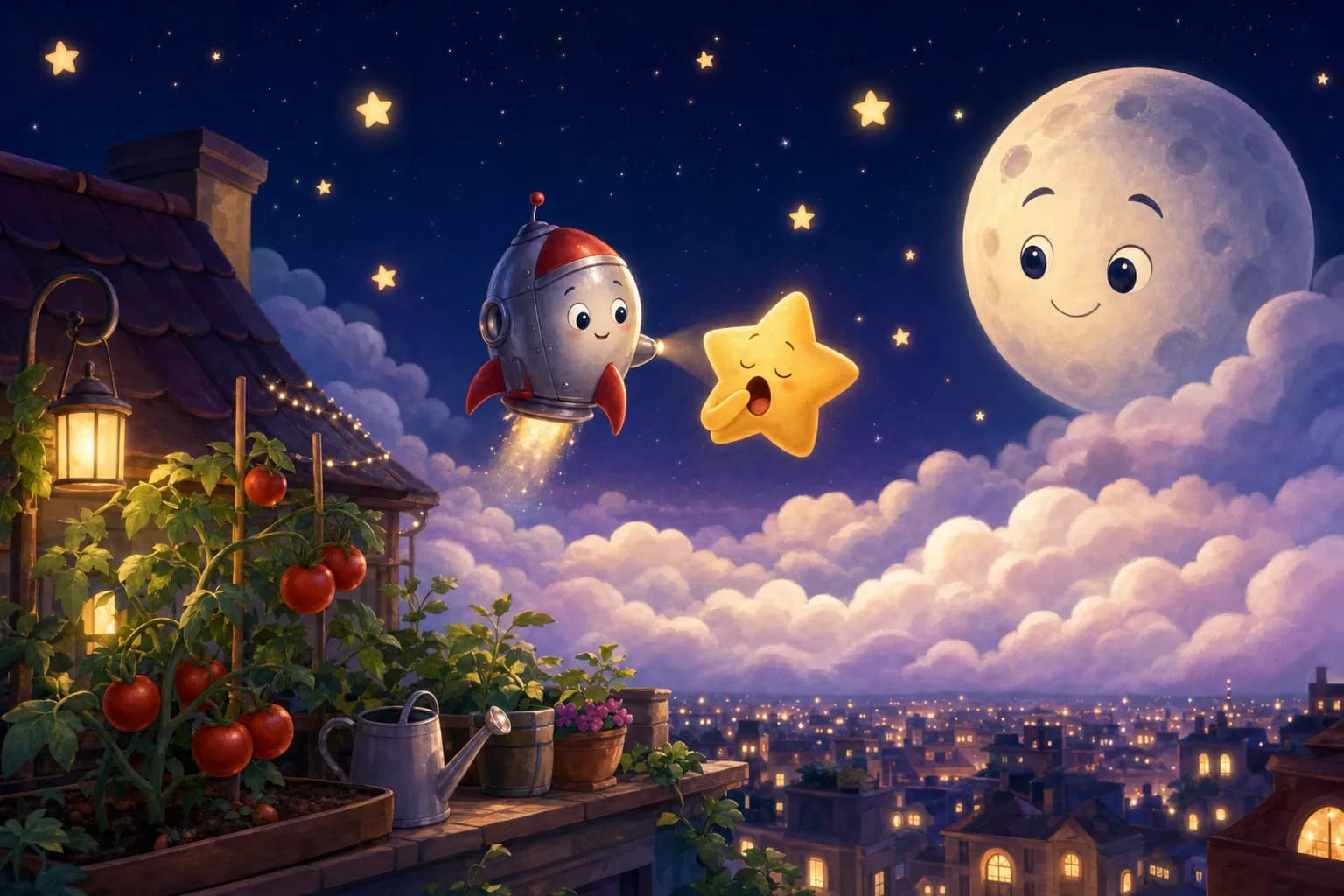
On the roof of a tall apartment building, in a garden of pots and tomato plants, there lived a little rocket named Pim.
Pim was no bigger than a watering can. He was silver, with a red nose and three small fins, and his engine made a sound like a kettle just before it whistles.
Every night, when the city lights came on below, Pim had one job. He flew up, past the rooftops, past the clouds, past the Moon, to say goodnight to the stars.
"Ready," said Pim, as the sky turned dark blue. He counted down, quietly, so as not to wake the tomatoes. "Three. Two. One."
Whoosh. Up he went.
The rooftops fell away. The streets became ribbons of light. The river became a silver thread. And then the clouds closed underneath him like a soft white floor, and it was quiet.
The Moon was waiting, round and pale and kind.
"Good evening, Pim," said the Moon. "They're restless tonight. Some of them don't want to go to sleep."
"I'll see what I can do," said Pim.
He flew on, slowly now, into the great dark field of stars.
The first star he came to was twinkling very fast. Blink, blink, blink, blink.
"What's the matter?" asked Pim.
"I'm not tired," said the star. "I want to keep shining."
"You can shine while you sleep," said Pim gently. "That's what stars do best. The children on Earth see you shine all night, and you don't even have to be awake for it."
The star thought about this. Its twinkling slowed. Blink. Blink. Then it settled into a steady, soft glow, like a night-light.
The next star was fidgeting, swinging back and forth on an invisible string.
"Sit still," said Pim, "and listen." And he turned his engine down low, until it hummed, and the humming floated out across the sky like a lullaby. The star stopped swinging and began, very slowly, to sway instead, the way a boat sways at anchor.
One by one, Pim visited the stars. To the ones who were cold, he said, "Snuggle closer to your neighbour." To the ones who were worried about the dark, he said, "The dark is just a blanket. It's what keeps you cozy." To the smallest ones, who could barely be seen, he said, "I see you. You're doing fine."
And one by one, the stars settled, until the whole sky was glowing softly and evenly, like a field of fireflies that had agreed to rest.
"Thank you, Pim," said the Moon.
But Pim did not answer right away. His engine had gone very quiet. His red nose was drooping, just a little.
"Oh dear," said the Moon kindly. "Who tucks in the rocket?"
She breathed out a long, slow beam of moonlight, and it caught Pim gently, the way a hand catches a falling leaf, and carried him down. Through the soft white floor of clouds. Past the ribbons of streetlight. Down to the roof garden, where the tomato plants were sleeping.
The moonlight set him on his launch pad, nose up, fins down, and drew back up into the sky.
"Goodnight, stars," whispered Pim.
And far, far above, every star in the sky glowed softly back, and the little rocket was asleep.
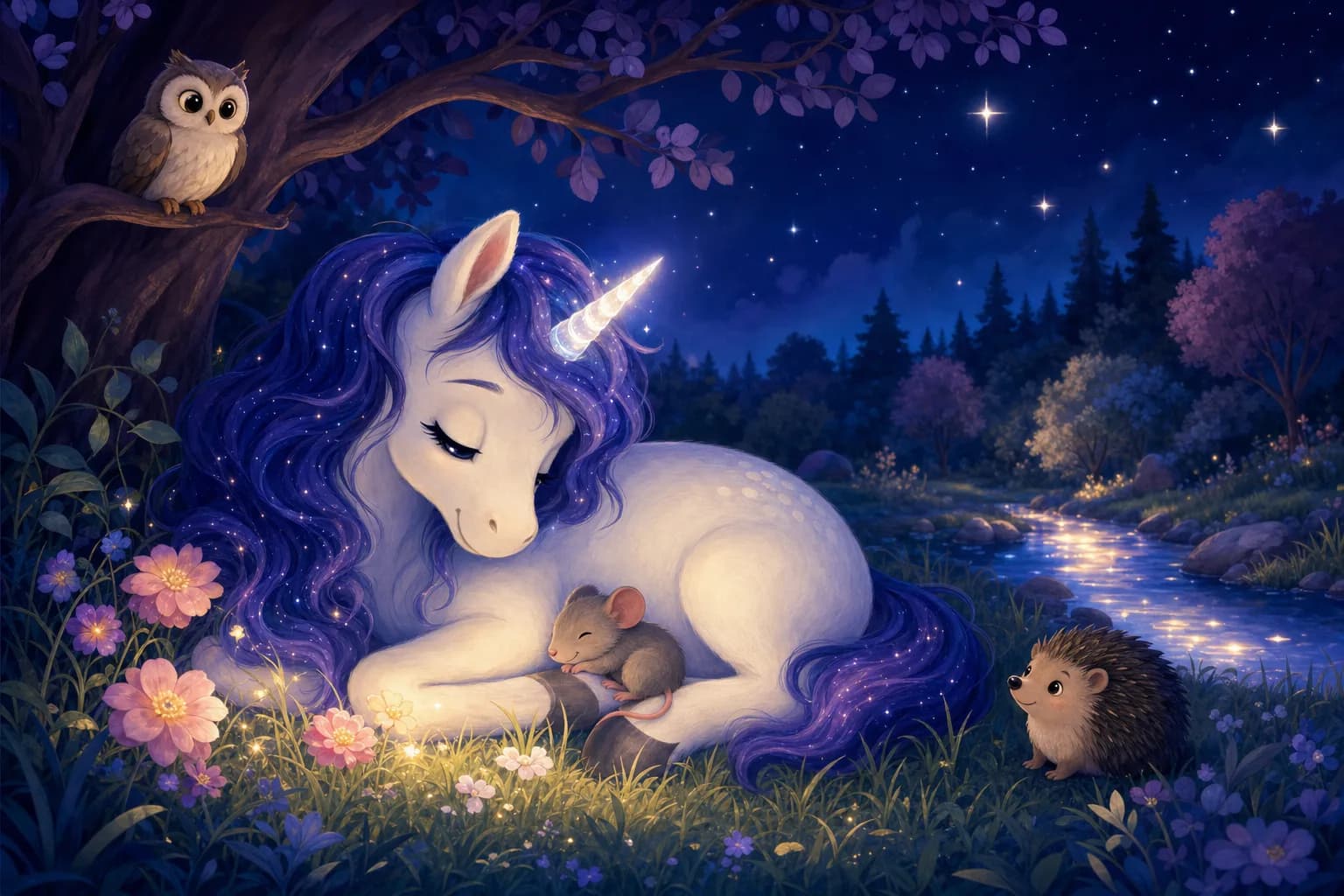
In a meadow at the edge of a forest, where the grass was always soft and the flowers never quite closed, there lived a young unicorn named Bluebell.
Bluebell was white as milk, with a mane the colour of the evening sky, and a horn that glowed.
It glowed in the morning like sunshine on water. It glowed in the afternoon like honey. And at night it glowed the softest of all, a pale silver light that the rabbits and the mice used to find their way home.
But one evening, as the first star came out, Bluebell looked up and saw that her horn was dark.
No sunshine. No honey. No silver. Just a plain white horn, like a stick.
"Oh no," said Bluebell. "I've lost my glow."
She looked for it everywhere. She looked under the big flat stone where the beetles slept. She looked in the hollow log. She looked in the stream, in case it had floated away, but all she saw was her own worried face looking back.
She asked the owl. "Have you seen my glow?"
"I have not," said the owl. "But you've been galloping about all day. Perhaps it's tired."
She asked the hedgehog. "Have you seen my glow?"
"I have not," said the hedgehog. "But you've been shouting across the meadow all afternoon. Perhaps it's gone somewhere quieter."
Bluebell sat down in the grass. Galloping. Shouting. It was true. She had done both all day, with the butterflies, and she had loved it. But now her legs ached, and her voice was scratchy, and her horn was dark.
A tiny mouse came and sat beside her. It was the smallest mouse in the meadow, and every night it used Bluebell's light to find its door.
"I can't help you tonight," said Bluebell sadly. "My light is gone."
"Maybe it isn't gone," said the mouse. "Maybe it's just resting. Why don't you rest with it?"
So Bluebell lay down in the soft grass, and folded her legs under her, and let her eyes half close.
She stopped galloping. She stopped shouting. She listened to the stream, saying the same quiet thing over and over. She felt the cool air on her nose. She let her breath go slow.
The mouse curled up against her warm side.
After a while, something tickled at the tip of Bluebell's horn. She did not look up. She stayed still.
The tickle became a warmth. The warmth became the faintest shimmer. And slowly, slowly, the way a candle takes a moment to catch, her horn began to glow.
Not sunshine. Not honey. Silver. The softest light of all. The night-time light.
"There it is," whispered the mouse. "It was waiting for you to be quiet."
All across the meadow, the rabbits and the mice saw the silver glow and found their way home to their beds.
Bluebell did not get up. She was far too comfortable. Her horn glowed gently over the sleeping grass, and the sleeping mouse, and the sleeping flowers that never quite closed.
And the unicorn who had lost her glow fell asleep in her own soft light.
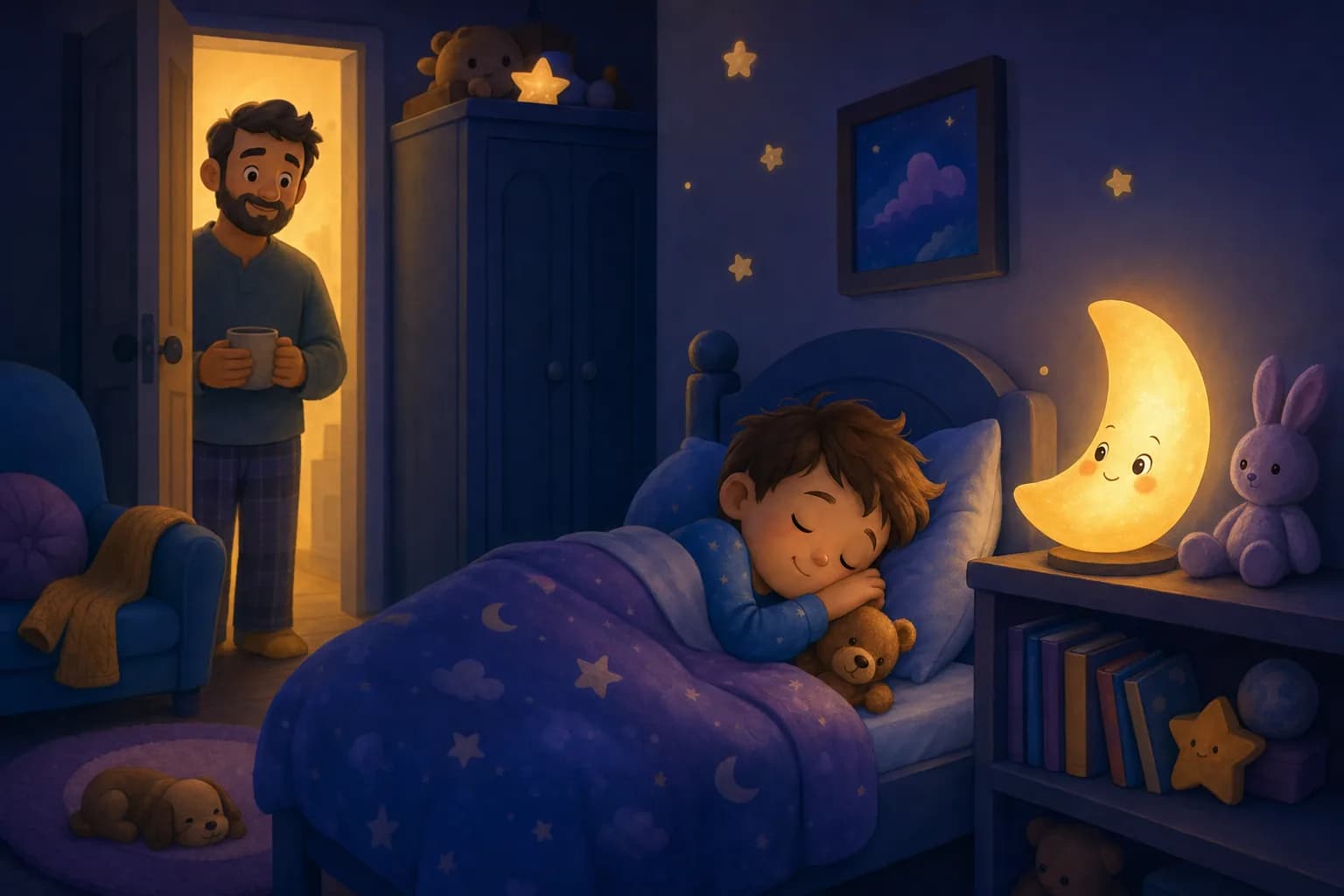
Theo's new night-light was shaped like a little moon, and she had only been switched on once, in the shop, for about a minute.
Now she sat on the shelf beside Theo's bed, and Theo's dad reached over and turned off the big light, and for the first time in her life, the night-light saw the dark.
It was everywhere. It filled the corners. It climbed the curtains. It made the chair by the window look like something crouching.
The night-light began to flicker.
"Are you all right?" whispered Theo, who was five, and who had been a little afraid of the dark himself once, and remembered.
"I don't like it," said the night-light in a small voice. "The dark is too big. I'm only little. What if I'm not enough?"
Theo thought about this. Then he sat up and patted the shelf.
"Come here," he said. "I'll show you something."
The night-light glowed a little brighter, bravely, and looked where Theo was pointing.
"That," said Theo, pointing at the crouching shape by the window, "is my chair. In the daytime it's blue. My jumper is on it. It's not crouching. It's just sitting, because that's what chairs do."
The night-light looked. The shape was a chair. It had a jumper on it. It was not crouching at all.
"And that," said Theo, pointing at the tall darkness in the corner, "is the wardrobe. My dinosaur pyjamas live in there. And that, up high, is the shelf with my books. And that, by the door, is my dad's shadow, because he's standing in the hall in case I need him."
"Hello," said Dad's shadow, in Dad's voice.
The night-light looked at the room again. The chair. The wardrobe. The books. The dad. It was the same room as before. It had just put on a dark blanket, the way Theo put on his.
"The dark isn't a thing," said Theo. "It's just the room, resting. Everything is still here. You can't see it as well, that's all."
"Then what am I for?" asked the night-light. "If everything is fine in the dark?"
Theo lay back down and pulled up his blanket.
"You're not for making the dark go away," he said sleepily. "You're for keeping me company while it's here. That's a much nicer job."
The night-light stopped flickering. She thought about her job. Keeping company. She could do that. She did not have to fill every corner. She just had to be a small, steady, friendly glow, right here, next to Theo.
She let her light go soft and warm, the colour of a biscuit.
The chair sat. The wardrobe stood. The books waited on their shelf for morning. Dad's shadow said goodnight and went to make a cup of tea.
Theo's eyes closed.
"Night-light?" he murmured.
"Yes?"
"You're enough."
And the little moon on the shelf glowed, softly and steadily, all night long, keeping company with the dark, which turned out to be nothing more than a room full of friends with a blanket on.
Anya was supposed to be asleep.
But something had changed in her room. The light coming through the curtains was different. Softer. Whiter. As if the streetlamp outside had put on a woolly hat.
She slid out of bed and pulled the curtain back, just a little.
Snow.
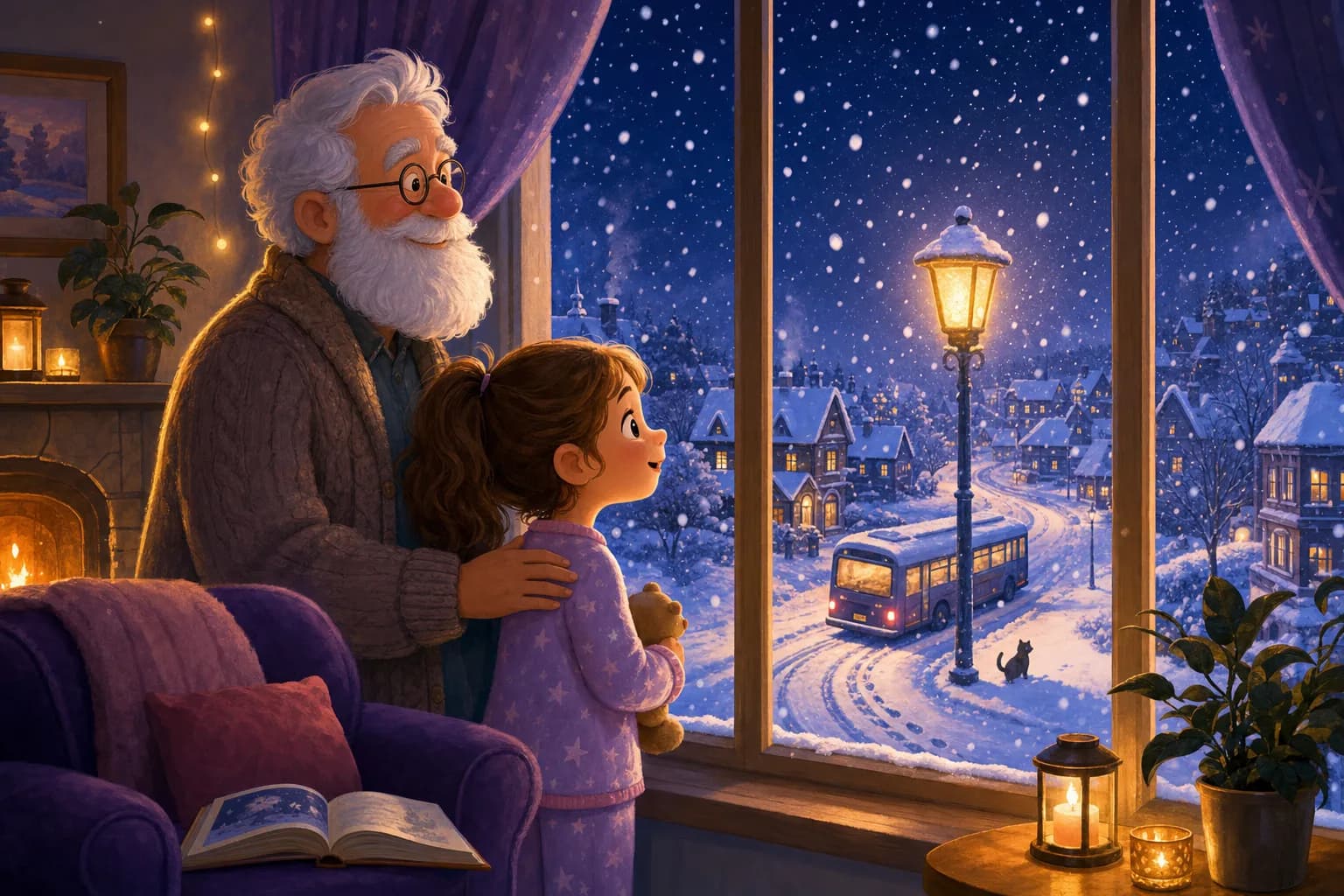
It was falling in big, slow flakes, turning in the lamplight, taking their time. The first snow of the year. The pavement was already white. The parked cars had white blankets. The bins had little white hats.
"Grandpa," she whispered, padding into the living room, where her grandfather sat with his book. "Grandpa, it's snowing."
Grandpa put down his book, and together they went to the big window and looked out at the town.
"Listen," said Grandpa.
Anya listened. And that was when she noticed the strangest thing of all.
The town had gone quiet.
Usually at night she could hear the cars on the big road, and the dog two doors down, and the train in the distance. But the snow was catching every sound and tucking it away, the way a blanket tucks away the cold.
"Snow is the quietest weather," said Grandpa. "Rain chatters. Wind shouts. But snow just says shhh."
They watched a flake land on the window. It held its shape for a moment, a tiny star with six arms, and then melted into a drop.
"Every flake is a different star," said Grandpa. "Nobody has ever found two the same. And they only fall at night like this when the whole sky is holding its breath."
Down in the street, a single cat walked across the fresh snow, lifting each paw high and shaking it, and left a line of small neat prints behind.
The baker's window went dark. The last bus slid by, slowly, with only the driver inside, and its tracks filled in again behind it.
"Where do the birds go?" asked Anya.
"Into the hedges," said Grandpa, "all fluffed up, close together. Where does the cat go?"
"Home," said Anya, watching the prints turn the corner.
"And where do the Anyas go?"
Anya yawned, a big one. The snow seemed to have tucked that away too, because it came out almost silent.
Grandpa carried her back to her room. He pulled the curtain open a little wider, so she could see the flakes still turning in the lamplight, and he tucked the blanket around her, right up to her chin.
"In the morning," he said, "the whole town will be new. Nobody will have walked on it yet. It will be waiting for your boots."
"Shhh," said Anya, who was almost asleep, in her best snow voice.
"Shhh," said Grandpa, and he turned out the light.
Outside, the flakes kept falling, slow and white and silent, over the quiet town, over the hedges full of birds, over the small neat cat prints, and over the window of a girl who was already dreaming about her boots.
Made for shared story time
A real story that fits the bedtime you have
A five-minute bedtime story should feel complete without becoming rushed. TaleLumi's short setting aims for a compact beginning, middle, and gentle ending shaped around the child and the story choices a parent selects.
Choose a calm, funny, magical, educational, or exciting tone. Add a favorite interest or an original companion, then choose a happy, silly, inspiring, or sleepy ending. The result is ready to read as soon as it is created.
Short stories also work well for morning reading, quiet time, waiting rooms, or a quick family reset between busy parts of the day.
Why it works
Personal enough to matter, simple enough for tonight
About five minutes
Choose the Short length when you want a compact story designed for a quick read-aloud.
A softer landing
Select a calm tone and sleepy ending for a story that settles rather than winds bedtime back up.
Easy to repeat
Save favorites, listen again, or continue the story as another chapter on a different night.
A short bedtime example
Noah and the Pocket-Sized Moon
Noah found the moon resting in his coat pocket. It was no bigger than a button and glowed just enough to light the hallway.
Together they tiptoed through the quiet house, returning tiny dreams to the cat, the clock, and the plant beside the stairs.
When every dream was home, Noah placed the moon back in the sky. It winked once through his window, and he was asleep before its light reached the pillow.
Every complete TaleLumi story is newly created from the choices a parent makes.
Built around real routines
When a short story is exactly enough
01
The second story
Offer one more complete adventure without quietly adding another half hour to bedtime.
02
A calm transition
Move from screens, travel, or an energetic day into a slower shared activity.
03
Early readers
Pair a shorter story with an appropriate reading level so the page feels inviting rather than overwhelming.
Wonder, written around them.
Turn what your child loves today into tonight's story.
Create one story now, then continue the adventure as a connected book tomorrow.
TaleLumi's Short setting is intended to create an approximately five-minute story. Actual reading time varies with the selected reading level and the pace of the reader or narrator.
Can a short story still be personalized?
Yes. Short stories use the same child, character, interest, language, tone, and ending choices as longer TaleLumi stories.
Can TaleLumi read the story aloud?
Yes. Parents can select an available approved narrator and play the story with read-along highlighting.
Can we make the story longer later?
You can continue a favorite as a new chapter, preserving the established book and its characters.